


With osteonecrosis, gradual destruction of spinal tissues occurs, leading to disruption of its function.Most often, such degenerative processes develop in almost all of its mobile parts.Young people often experience cervical spondylosis.The instability of this part, combined with increased physical activity, explains its vulnerability to injuries and various degenerative processes.In 10 cases, 3 are the cause of sudden headaches.Osteonecrosis causes metabolic disorders in the spine.Because of this, the discs in it swell and then crack.
Symptom
Certain signs may indicate dystrophic changes in the spine.Depending on the stage of the disease, they manifest more or less.Cervical spondylosis has the following symptoms:
- Pain in the neck, back of the head, and shoulders.Enhanced even under light loads.
- Numbness in the limbs.
- Crunching when turning the neck.
- Headache, localized mainly in the back of the head and temples.
- Fainting, chronic fatigue.
- Tinnitus, hearing loss.
- Loss of vision.
Persistent pain in the heart area can also be a sign of cervical spondylosis.Patients often have a feeling similar to angina.When spinal roots are compressed, other disorders will occur.For example, loss of tongue sensitivity or decreased neck muscle tone, difficulty breathing.If timely treatment is not prescribed, the patient may develop a protrusion or hernia.
There are four stages of osteoarthritis.The first is characterized by instability of the intervertebral discs.On the second day, the main symptom is considered protrusion.At the same time, the distance between the vertebrae becomes increasingly smaller.Pain syndrome occurs, possibly related to nerve root compression.
In the third stage, destruction of the annulus fibrosus, an integral part of the intervertebral disc, occurs.That is why its deformation subsequently occurs.A patient with stage four cervical spondylosis will feel severe pain when moving.It is worth noting that a decrease in its intensity does not indicate recovery.In turn, this shows that the process of forming bone spurs connecting the vertebrae has begun.As a rule, this leads to disability.Treatment is prescribed based on clinical signs and the stage of development of the pathology.
Cause of the disease
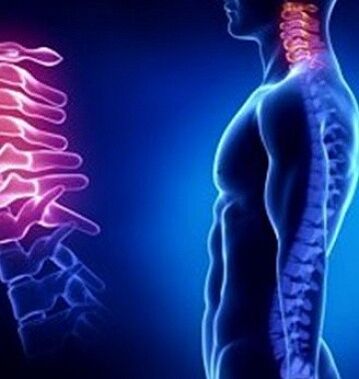
Sedentary work often accompanies cervical spondylosis.This part of the spine is quite compact, so even slight muscle tension can lead to compression of nerve endings and blood vessels.Against this background, bone spurs often form, which only makes the situation worse.In addition to a sedentary lifestyle, the disease can be triggered by:
- metabolic disorders;
- unhealthy diet;
- salt deposition in the cervical spine;
- hypothermia;
- genetic predisposition;
- cervical spine injury;
- rheumatism.
The development of the disease can also be caused by a curved spine or being overweight.People with poor physical fitness or athletes who make mistakes during training are at risk of getting the disease.
Which doctor treats cervical spondylosis?
To avoid the development of complications, at the first signs of spinal nerve root compression, you should seek help from a specialist.Cervical osteoarthritis and its symptoms are treated by neurologists, chiropractors, and osteopaths.
Additionally, you may need to consult a neurosurgeon, traumatologist, therapist, or cardiologist.To differentiate the diagnosis, the doctor analyzes the patient's complaints.At this stage, he asks the patient the following questions:

- When did neck pain first appear?
- Does cervical spondylosis come with other symptoms?
- Does the patient's occupational activities involve lifting heavy objects or keeping the neck immobile for long periods of time?
- What is the patient's physical level?
- Does the patient have signs of neurological disorders?
To evaluate the condition of the spine, doctors prescribe X-rays, CT or MRI.Depending on the symptoms and stage of the disease, treatment may include massage, swimming and exercise.The process of local destruction is influenced by the use of acupuncture.In case of severe pain, the doctor prescribes anesthetics.Tension in the muscles is reduced with muscle relaxants.In severe cases, when the patient has a hernia that compresses the spinal root, surgical intervention is required.
What if the disease is not treated?
In the absence of qualified medical care, the patient will eventually suffer from chronic pain in the cervical spine.It spreads to the upper and lower limbs, possibly leading to paralysis.As bone spurs develop, they compress nerve tubes, veins, and arteries.This can disrupt cerebral circulation.This often causes spinal ischemia and stroke.The patient's vision and hearing also decline, migraines and vegetative-vascular dystonia appear.
By studying cervical spondylosis and its clinical symptoms, doctors often diagnose radiculopathy.It leads to partial or complete loss of mobility of the vertebrae.The occurrence of exacerbations is the reason for hospitalization.The most serious consequence of cervical spondylosis is considered spinal cord compression.The risk of death is quite high.To avoid the development of complications, it is necessary to consult a doctor as soon as possible.Work schedule should be light.You should do special exercises every day and, if possible, exercise in the morning.